Last week, a BYD Atto 3 survived a missile blast in Jerusalem. The internet called it a miracle. Military analysts called it survivable blast geometry. We called it a stark reminder that structural integrity is paramount—and it prompted a question that few were asking:
What happens when the vehicle subjected to that level of stress is a purpose-built, body-on-frame truck rather than a unibody crossover?
For buyers operating in markets defined by punishing roads, vast distances, and limited service infrastructure, the answer is critical.

Two Fundamentally Different Architectures
Modern passenger vehicles—including the BYD Atto 3, most crossover SUVs, and the majority of EVs—rely on unibody construction. In this design, the body and chassis form a single, welded structure. This approach excels in providing ride comfort, fuel efficiency, and crash performance in standardized tests (front, side, and rollover impacts).
However, it is not the optimal choice when the pavement ends.
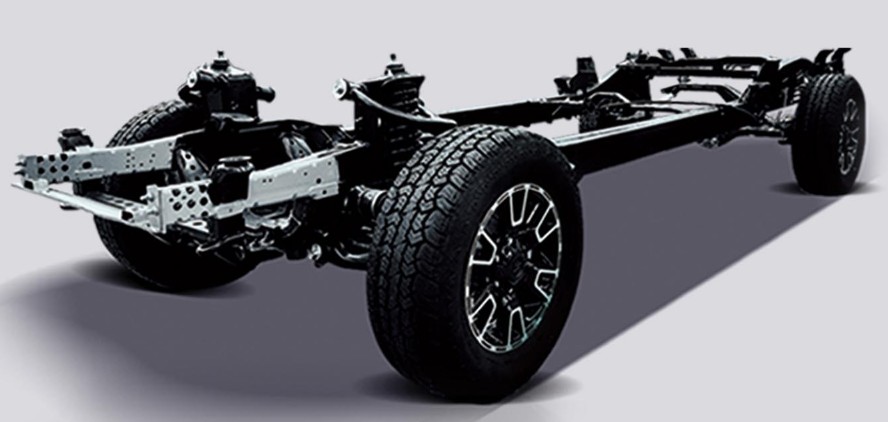
Body-on-frame construction is precisely what its name implies: a separate, rigid frame—typically a high-strength steel ladder design—upon which the vehicle body is mounted. The frame bears the structural load; the body houses the occupants. Under extreme torsional stress—such as navigating a rutted track, fording a river, or traversing loose terrain at speed—the frame and body flex independently. This design prevents cracking, warping, and permanent deformation.
This is why legendary off-roaders still exist. This is why body-on-frame trucks consistently outsell unibody rivals in East Africa. Body-on-frame is not legacy technology; it is the correct engineering solution for specific, demanding operating conditions.
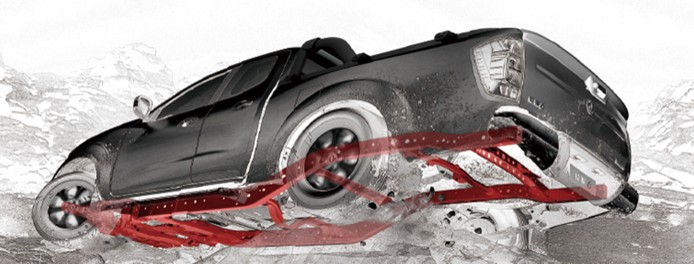
Where Unibody Falters in the Real World
Unibody construction rarely “fails” catastrophically in normal use. Instead, it degrades. And in regions lacking dense service networks, degradation is functionally equivalent to failure.
- Structural Fatigue on Rough Roads: Unibody vehicles are engineered to flex within defined limits. Repeated stress beyond those limits—a daily reality on unpaved routes across Central Asia, the Sahel, and parts of the Middle East—induces micro-cracking at weld and stress points. This manifests as squeaks and rattles, progresses to alignment issues, and eventually requires specialized repair facilities.
- Repairability: A bent or cracked ladder frame can often be straightened or welded by a competent local fabricator using basic equipment. Conversely, a distorted unibody demands factory jigs, computerized measurement systems, and specific replacement panels—resources often unavailable in remote areas of Almaty, Nairobi, or Tbilisi.
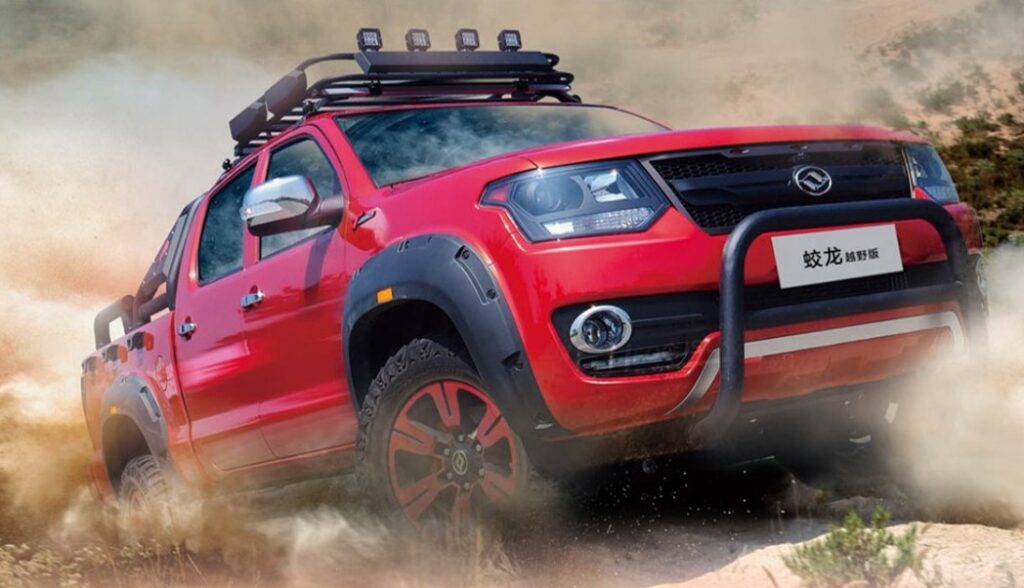
- Clearance and Approach Angles: Body-on-frame platforms are inherently designed for elevated ride heights and steep approach/departure angles. Unibody crossovers typically achieve ground clearance through suspension tuning rather than foundational structural design. This difference is stark when comparing a vehicle like the Huanghai N7—with its 220mm clearance and aggressive approach angle—to a crossover whose low front fascia contacts the terrain before its wheels do.
- Powertrain Accessibility: Ladder-frame vehicles inherently offer more space between the body and frame, granting mechanics easier access to critical components. Filters, pumps, and driveline parts can often be serviced without specialized lifts or major structural disassembly. In field maintenance scenarios, this translates to repairs taking hours rather than days.
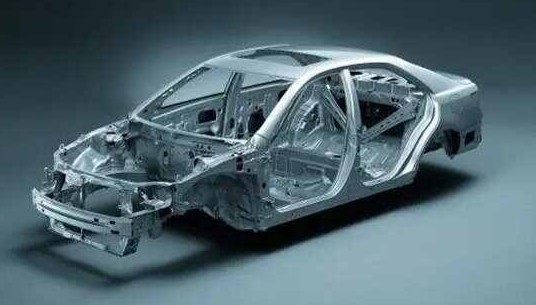
The Maturation of the Chinese Body-on-Frame Market
Five years ago, the decision to purchase a Chinese body-on-frame truck depended heavily on the specific manufacturer. Quality variance was significant, and component sourcing was inconsistent.
That landscape has transformed.
The manufacturers that have thrived in China’s fiercely competitive domestic commercial vehicle market—and have built the infrastructure for international export—now represent the pinnacle of Chinese manufacturing capability. They compete not just on price, but on rigorous certification, robust after-sales support, and proven performance in extreme environments.
Consider the DF-NISSAN OTING. Its successful completion of Kazakhstan Ministry of Defense field testing—enduring 1,803km of desert, sand, and swamp fording to meet military procurement standards—is a documented operational reality, not mere marketing copy. Similarly, the HUANGHAI N-Series platform, utilizing a Mitsubishi-sourced engine and a professional racing-derived chassis, is a genuine workhorse with a proven lineage.

The Jerusalem Comparison, Contextualized
Returning to the BYD incident: The structural performance of that unibody passenger vehicle was undeniably impressive. It maintained cabin integrity, the battery did not ignite, and the occupants survived.
However, consider the same scenario with a body-on-frame vehicle.
A ladder frame absorbs and distributes energy differently than a unibody shell. The elevated ride height alters the interaction geometry. The isolation provided by body mounts means the cab structure is not directly coupled to frame deformation. This is why military vehicles—from patrol trucks to armored personnel carriers—are almost universally body-on-frame or purpose-built monocoques, rather than unibody derivatives.
We are not suggesting our clients require vehicles designed to survive missile strikes. We are illustrating that the engineering principles making body-on-frame trucks superior at handling extreme mechanical stress—frame rigidity, energy distribution, and structural isolation—are the exact principles that make them the correct choice for commercial operations in demanding environments.
The BYD Atto 3 performed admirably under conditions it was never designed for. The Huanghai N-Series and the OTING are specifically engineered for conditions that would prematurely age a unibody crossover.
Practical Guidance: Making the Right Choice
Choose Body-on-Frame When:
- Primary use involves unpaved roads, construction sites, agricultural terrain, or mining access.
- Payload requirements frequently exceed 800kg.
- Operations occur more than 200km from major service infrastructure.
- Expected vehicle lifespan under commercial use is 5+ years.
- The regional resale market heavily favors robust working trucks over crossovers.
Unibody May Be Appropriate When:
- Operations are primarily urban or highway-based.
- Passenger comfort is the overriding priority.
- An electric or hybrid powertrain is essential.
- Operating in markets with mature EV charging infrastructure.
For the majority of commercial buyers in Central Asia, East Africa, the Gulf (outside major metropolitan areas), and the Caucasus region, body-on-frame remains the definitive answer. The terrain, the distances, the service realities, and the operational demands all dictate this choice.
The Crucial Importance of Authorized Channels
One final point must be emphasized.
While the quality gap among top-tier Chinese manufacturers has narrowed, the gap between authorized and non-authorized supply channels remains vast. A vehicle sourced through a factory-authorized export partner—complete with current ECE and OTTC certifications—is a fundamentally different product in terms of documentation, warranty validity, and parts availability compared to an identical-looking unit acquired through informal gray markets.
In the realm of commercial vehicles, the long-term cost difference between these two paths is substantial. The complications arising from unverified imports consistently negate any initial price savings within the first few years of operation.
Buy the right platform. Buy it through the right channel.
KUN MOTORS supplies authorized, rigorous body-on-frame commercial vehicles—including the Huanghai N7, Huanghai N2S, Dongfeng-Nissan Oting, Z9, and SAIC Maxus D90—backed by full OEM authorization, current market certifications, and comprehensive factory support. Contact us at kunmotors.com.